
Coordinated campaigns often run on more than one platform at once. This post looks at how they move, using a recent platform threat report, one researcher’s map of how false narratives reach the news, and Rolli’s own published analyses.
Meta describes this in its own work. In its first-half 2026 Adversarial Threat Report, published in March 2026, Meta wrote that operators of coordinated inauthentic behavior “rarely confine their activities to a single platform.” One network it removed, which Meta attributed to the Pakistani military’s Inter-Services Public Relations wing, centered its content on several media brands, chief among them a blog called The Balochistan Diaries. According to the report, the network drove traffic to its own website and kept a presence on X and YouTube alongside its Facebook and Instagram accounts.
The stages below follow that researcher’s map. The Rolli analyses in Stage 2 each look at a narrative once it was already in the open, on X or across X, Reddit and Facebook; none of them traces a narrative moving from one platform to another.
“That mix can make a narrative hard to read: the real people in it are real, and the coordination sits in the accounts around them.”
Stage 1: Seeding on the Anonymous Web and in Closed Groups
In a December 2018 article for First Draft, the researcher Claire Wardle mapped where disinformation tends to begin. She wrote that it “often starts on the anonymous web,” then passes through closed or private groups and conspiracy communities on Reddit and YouTube before it reaches open networks such as Twitter, Facebook and Instagram.
Illustrative example: a handful of accounts in a closed group drafts several versions of a claim about Pellbrook Energy, a fictional company, and keeps the version that draws the most replies before anyone posts it publicly.
Stage 2: Out in the Open
On open networks, coordinated activity sits next to real conversation, and the two can be hard to tell apart. Rolli’s published analyses show what that looks like.
Rolli’s analysis of #BanTheADL, a hashtag campaign on X, concluded that the narrative was “both an organic movement among real conservative commentators and a manufactured amplification effort by clusters of inauthentic accounts.” One cluster used Donald Trump’s mugshot as a profile image, and its accounts, dozens of them, were created between October 2020 and September 2023.
That mix can make a narrative hard to read: the real people in it are real, and the coordination sits in the accounts around them.
Rolli’s analysis of the TSA PreCheck announcement, published on February 24, 2026, found that the conversation spread across X, Reddit and Facebook. Roughly 58% of the initial burst came from a cluster of accounts sharing near-identical language, posting within tight time windows and retweeting each other at above-baseline rates. Travelers with established posting patterns were more skeptical.
Action by one platform has limits. In Rolli’s analysis of #SchuldenDE, an anti-Ukrainian campaign on X, “Twitter had demoted several hashtags including #SchuldenDE, but accounts that were spreading it remained active.”
Stage 3: Mainstream Amplification and the Media Pickup Problem
The final stage is coverage. Wardle wrote that, for many of the people spreading disinformation, getting picked up by a mainstream outlet is the point. A newsroom can amplify a false claim by repeating it without checking it, and also by debunking it: “Either way, the agents of disinformation have won.” She added that debunks can be very valuable and are usually in the public interest, as long as they are handled with care.
Whitney Phillips’s 2018 report for Data & Society, The Oxygen of Amplification, drew on interviews with journalists; Data & Society describes it as showing “how news media was hijacked from 2016 to 2018 to amplify the messages of hate groups.”
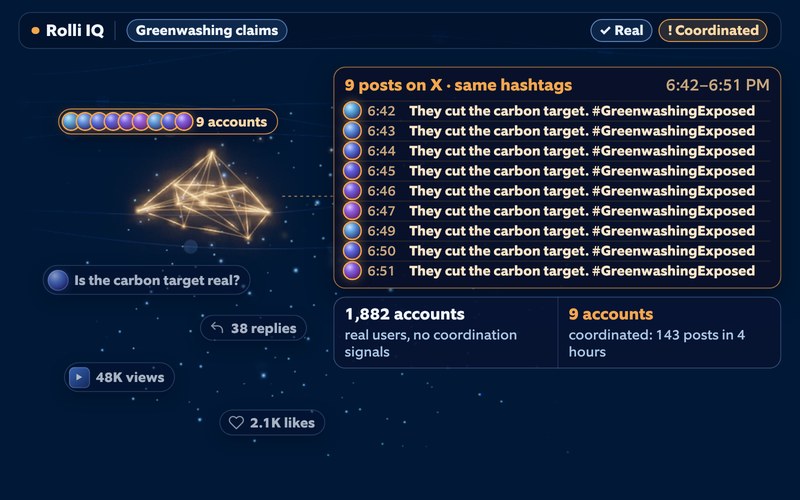
The problem for a reporter, or for a communications or security team deciding whether to respond, is that volume is easy to see and its origin is not. Rolli IQ is built for that second question. It gives each investigation a coordination score from 0 to 100, detects coordination, and shows the evidence behind each flag, across 9+ platforms.
Conclusion
No single platform sees the whole path. Meta’s investigation into the Balochistan Diaries network began with information shared by another company. The practical question for a newsroom, a communications team or a security team is the same at every stage: before acting on a narrative’s volume, check whether the volume is real.
Related to this topic: Rolli IQ · Methodology
About the Author
Rolli Newsroom
Analysis and intelligence research published by the Rolli IQ team.
RelatedPlatform overview →Rolli IQ scoring →API access →Security intelligence →Communications →Pricing →