

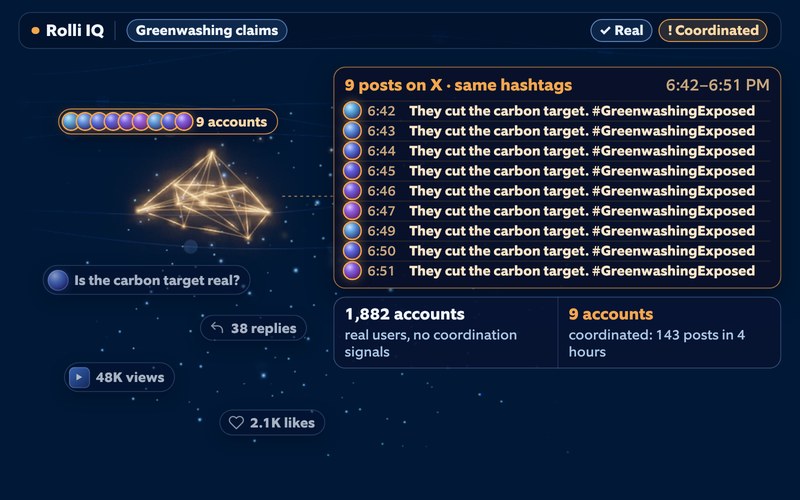
Coordinated inauthentic behavior, or CIB, is the name Meta gives to the covert influence networks it removes from Facebook, Instagram and its other apps. The term is often used loosely, as a synonym for bots or for misinformation. This explainer sets out what it means, using Meta’s own definition and Rolli’s published analyses of campaigns that fit it.
In its H2 2026 Adversarial Threat Report, published in August 2026, Meta says CIB involves networks of accounts “working together to mislead people using false identities.” Meta says it enforces against that behavior, not the content: it removes these networks whatever they post, and whether they are foreign or domestic.
What counts as inauthentic behavior
An earlier Meta report, from May 2025, put it this way: CIB is “coordinated efforts to manipulate public debate for a strategic goal, in which fake accounts are central to the operation.”
The inauthentic part is about identity, not truth. The people behind a CIB network pretend to be someone they are not, so that a coordinated effort looks like many independent voices. A network of fake accounts can push a true news story, and one honest person can share a false one. Under Meta’s definition, only the first is CIB.
Rolli’s analysis of #SchuldenDE, an anti-Ukrainian campaign on X, shows what false identities look like in practice. It found 1,341 highly coordinated accounts presenting themselves as Germans: every account listed a German city as its location, and the account descriptions were German quotes that Rolli traced to Russian websites. One misspelled city name, used as a location by six of the accounts, appeared with the same misspelling on a Russian website.
Illustrative example: if Corvane Airways, a fictional airline, used its own accounts to promote a new route, that would be coordinated but open, and not CIB. If it paid for a set of accounts posing as unrelated travelers to post the same praise, it would be.
The coordination component
Coordination can be run by software, by people, or by both, and it often sits next to real conversation. Rolli’s analysis of #BanTheADL, a campaign on X in August 2023, found real commentators with real views alongside clusters of accounts that used Donald Trump’s mugshot or Pepe the Frog as profile images and retweeted the same accounts. One account had liked 334,700 posts by September 2023, an average of 1.55 likes a minute, which Rolli said pointed to automated software or a full-time operator.
Rolli’s #No2ULEZ analysis, on a campaign against London’s Ultra Low Emission Zone, looked across Twitter, Facebook, Instagram, YouTube and Reddit. It found that two of the three anti-ULEZ campaign websites shared an IP address, and that posts per user ran above baseline on Facebook, Instagram and Twitter, which Rolli read as a sign of amplification rather than organic conversation. Its conclusion was that the campaign combined genuine users with inauthentic actors.
Detection approaches used by platforms and researchers
Platforms and outside researchers see different data. Meta says the networks in its August 2026 report were identified through behavioral signals, technical indicators and network analysis, and that it uses automated and manual detection to remove networks that try to come back after a takedown.
Researchers working from public data see only what is public, so they look for patterns that independent accounts are unlikely to share. In #SchuldenDE, Rolli used three methods: finding the five accounts that posted most often, mapping how the hashtag spread, and searching for combinations of hashtags and narratives the accounts used. Rolli combined the results into 1,341 accounts and reported all of them to X’s Threat Disruption Team.
Rolli IQ works from the same kind of public signals. Rolli’s methodology describes its coordination score as a weighted composite of four signal families, velocity and timing, account behavior, network structure, and content and language, and says no single signal is proof of inauthenticity. Rolli IQ gives each investigation a coordination score from 0 to 100, detects coordination and shows the evidence behind each flag, across 9+ platforms.
Conclusion
CIB is narrower than the way the term is often used. It is not every bot and not every false claim: it is people coordinating behind fake identities to hide who is really speaking. That definition points detection toward behavior: whether the accounts are who they claim to be, and whether they move together in ways independent people would not.
About the Author
Rolli Newsroom
Rolli's research team covers narrative intelligence, influence operations, coordinated inauthentic behavior, and cross-platform social analysis.
RelatedPlatform overview →Rolli IQ scoring →API access →Security intelligence →Communications →Pricing →