

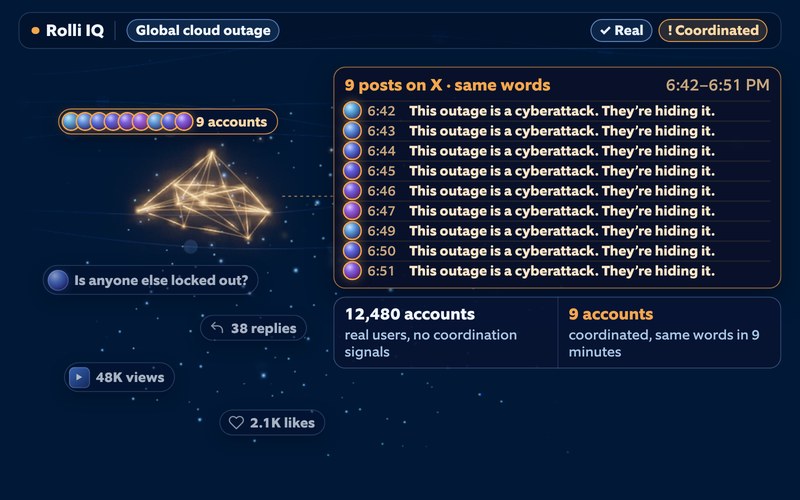
Social monitoring tells a communications team what is being said. Narrative intelligence asks the next questions: whether the conversation is real, where it is happening and how it is moving. This guide sets out what that means, using Rolli’s published analyses and the profession’s own measurement standards.
The core problem is that volume looks the same whether it comes from the public or from a coordinated campaign. In Rolli’s analysis of the TSA PreCheck expansion, roughly 58% of the first burst of conversation came from one cluster of accounts using near-identical language; read as a whole, the conversation looked like enthusiasm.
What narrative intelligence adds
Rolli’s methodology describes four signal families behind its coordination score: velocity and timing, such as how many accounts post within narrow windows and whether spikes appear on several platforms at once; account behavior, such as new accounts with high post volumes; network structure, such as clusters of accounts that amplify each other abnormally; and content and language, such as near-identical posts. It says no single signal is proof of inauthenticity.
The same signals can show that a story is organic. In Rolli’s Labubu analysis, only 11% of amplification on X came from the top 10% of accounts, within the normal range for organic content.
Rolli IQ gives each investigation a coordination score from 0 to 100, detects coordination and shows the evidence behind each flag, across 9+ platforms. Rolli describes the score as probabilistic: an aid for human decision-makers, not an automated verdict.
Building your narrative intelligence program
Deciding whether to respond is often the hardest part. In a December 2018 article for First Draft, Claire Wardle warned that a newsroom can amplify a false claim both by repeating it and by debunking it, while adding that debunks still have value when they are done carefully. A company’s public response raises the same question.
Measurement standards address a related problem: how much weight a source deserves. AMEC’s Barcelona Principles 4.0, published in June 2025, ask measurement programs to be clear about their data sources, to set a policy for weighing sources of different trustworthiness, naming bot accounts on social media as an example, and to keep a human in the loop when they use AI or automation.
Illustrative example: Wrenmoor, a fictional company, agrees in advance who sees a narrative report, what share of coordinated activity is worth escalating, and who decides whether to respond publicly. When a spike arrives, the team spends its time on the evidence rather than on the process.
Conclusion
Narrative intelligence does not replace social monitoring; it adds the questions monitoring leaves open. Is the conversation real? Where is it? How is it moving? Rolli’s analyses show the answers can point either way, toward a coordinated campaign or toward genuine public interest, and a team needs to know which before it responds.
About the Author
Rolli Newsroom
Analysis and intelligence research published by the Rolli IQ team.
RelatedPlatform overview →Rolli IQ scoring →API access →Security intelligence →Communications →Pricing →