
Glossary
Astroturfing detection
Definition and plain explanation. Last reviewed October 13, 2026.
Astroturfing detection
Where the word comes from
The word plays on AstroTurf, the artificial grass. It is usually attributed to US Senator Lloyd Bentsen, who used it in 1985 to describe orchestrated letter-writing campaigns that imitated grassroots mail. Online, the same tactic uses accounts instead of letters.
Astroturfing detection
What astroturfing looks like online
- Fake accounts and sock puppets posting as if they were ordinary customers, voters or patients.
- Paid posters, troll farms or agencies producing volume on behalf of an undisclosed client.
- Real accounts, sometimes employees or contractors, coordinated to post without disclosing who asked them.
- Reviews, petitions, comments on regulatory dockets and letters to editors generated by a campaign and presented as independent.
- Influencer posts and “organic” testimonials with undisclosed payment.
Astroturfing detection
The signals
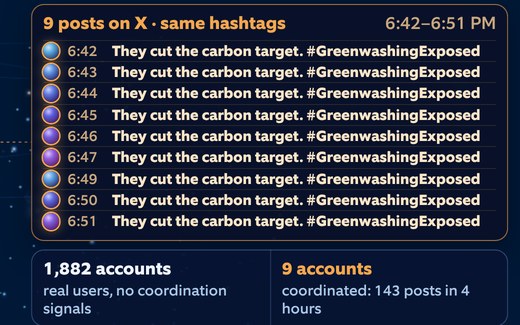
Bursts of near-identical messages. New or dormant accounts activating together. Posting schedules that do not look human. A small number of accounts producing most of the volume. The same content appearing on several platforms at once. Little of the texture of real conversation: no disagreement, few replies, no follow-up. And an origin that traces back to a handful of seed accounts rather than to many independent starting points.
Astroturfing detection
How detection works
Detection treats the campaign as a network rather than as a pile of posts. Analysts and software look at timing (do posts cluster unnaturally), accounts (when were they created, what else do they do), network structure (who amplifies whom) and content (how much is copied). Because real grassroots movements also produce bursts of similar posts, the result is a probability with evidence, reviewed by a person, not an automatic verdict. See the coordination score and coordinated inauthentic behavior entries.
Astroturfing detection
Why it matters for communications teams
A brand facing a “boycott” needs to know whether it is 2,000 customers or 20 accounts. Regulators, investors and journalists ask the same question. Responding to manufactured outrage as if it were real can amplify it, and dismissing real anger as bots is worse. In the United States, the Federal Trade Commission's 2024 rule bans fake reviews and testimonials, and every major platform prohibits platform manipulation, so a company can also be a victim of astroturfing aimed at it or be held responsible for astroturfing done on its behalf.
Astroturfing detection
How Rolli IQ handles it
Rolli IQ maps the engagement behind each post to show whether a narrative is spreading organically or being pushed by a small group of coordinated or automated accounts. It gives each narrative a coordination score from 0 to 100, assesses coordination, and shows the accounts amplifying the narrative with the evidence behind each flag. The method is described at rolli.ai/methodology/.
Astroturfing detection
Related terms
Coordinated inauthentic behavior. Coordination score. Narrative intelligence. Sock puppet account. Computational propaganda.
Questions people ask
Is astroturfing illegal?
It depends on the form and the country. In the United States, fake reviews and testimonials are banned by the Federal Trade Commission's 2024 rule, and undisclosed paid endorsements break FTC guidelines. Platform rules prohibit fake accounts and manipulation. Many forms are legal but deceptive, which is why detection matters to the organizations targeted by it.
How do you tell astroturfing from a real grassroots campaign?
Look at the accounts and the pattern, not the message. Real movements show diverse accounts with histories, varied wording, disagreement and replies, and many independent starting points. Astroturfing shows batches of similar accounts, copied text, synchronized timing and a small core driving the volume.
Can astroturfing use real people?
Yes. Paid posters, undisclosed employees and coordinated supporters are real people. What makes it astroturfing is the hidden sponsor and the false appearance of spontaneous support.