
Glossary
Narrative intelligence
Definition and plain explanation. Last reviewed October 13, 2026.
Narrative intelligence
Where the term comes from
The phrase grew out of disinformation research and security work in the early 2020s, as vendors and analysts needed a word for something broader than “social listening” and narrower than “intelligence”. It became a recognized software category in 2026, when Gartner published an Emerging Market Quadrant for narrative intelligence and began listing vendors in a Narrative Intelligence market on Gartner Peer Insights.
Narrative intelligence
What narrative intelligence involves
| Capability | What it does |
|---|---|
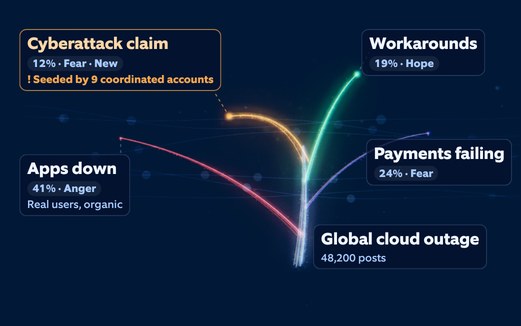
| Narrative detection | grouping posts, videos and articles into the storylines they belong to, rather than counting keyword matches. |
| Actor analysis | identifying the accounts, communities and outlets that originate and amplify each storyline. |
| Coordination analysis | estimating whether amplification comes from independent people or from coordinated or automated accounts. |
| Cross-platform tracking | following a storyline as it moves between platforms, since a narrative that starts on one often spreads to others. |
| Velocity and timing | measuring how fast a narrative grows and when it spikes. |
| Prioritization | separating storylines that need a response from the many that do not. |
Narrative intelligence
How it differs from social listening
| Question | Social listening / Narrative intelligence |
|---|---|
| What is being said about us, and how much? | Yes / Yes |
| Is this spike real public opinion or manufactured? | No / Yes |
| Who is driving it, and are they coordinated? | No / Yes |
| Unit of analysis | Mentions and keywords / Storylines and the networks behind them |
| Typical output | Volume, sentiment, share of voice / Coordination assessments, actor maps, evidence |
| Typical buyer | Marketing and PR teams / Communications, brand risk, trust and safety, security and public sector teams |
The two are complementary. Many teams keep a listening tool for volume and sentiment and add narrative intelligence for the question listening cannot answer: is this real?
Narrative intelligence
Who uses it
Corporate communications and crisis teams, brand risk and trust and safety teams, OSINT and security operations (GSOC) teams, public sector and election integrity teams, newsrooms and researchers.
Narrative intelligence
Vendors in the category
Vendors associated with the category include, in alphabetical order, Alethea, Blackbird.AI, Cyabra, Logically, PeakMetrics and Rolli IQ. Others overlap from social listening and threat intelligence. This page does not rank them.
Narrative intelligence
How Rolli IQ approaches it
Rolli IQ is a narrative intelligence platform for security, investigations and risk teams. It shows whether an online threat or narrative is organic or coordinated, which public accounts are driving it, and how it spreads across X, Reddit, YouTube, TikTok, Facebook, Instagram, Threads, Bluesky, LinkedIn and more. It gives each narrative a coordination score from 0 to 100. See the coordination score entry and rolli.ai/methodology/.
Narrative intelligence
Related terms
Coordinated inauthentic behavior. Coordination score. Astroturfing detection. Influence operation. Social listening.
Questions people ask
Is narrative intelligence the same as social listening?
No. Social listening measures what is being said and how much. Narrative intelligence adds who is saying it, how it spreads and whether the activity is authentic. Most teams use both.
What does a narrative intelligence platform produce?
Storylines rather than keyword counts, the accounts and communities behind each one, an assessment of whether the amplification is organic or coordinated, and the evidence for that assessment.
Who needs narrative intelligence?
Any organization that has to decide, under time pressure, whether an online story about it is real public opinion or a manufactured campaign: communications teams, trust and safety teams, security teams, governments and newsrooms.