
Glossary
Coordinated inauthentic behavior
Definition and plain explanation. Last reviewed October 13, 2026.
Coordinated inauthentic behavior
Where the term comes from
Meta introduced the term in 2018 to describe the networks of fake accounts it removes from Facebook and Instagram. Its definition centers on coordinated efforts to manipulate public debate for a strategic goal, in which fake accounts are central to the operation. The term is now used across platforms, research groups and governments, though each platform enforces its own version of the rule.
Coordinated inauthentic behavior
What CIB looks like
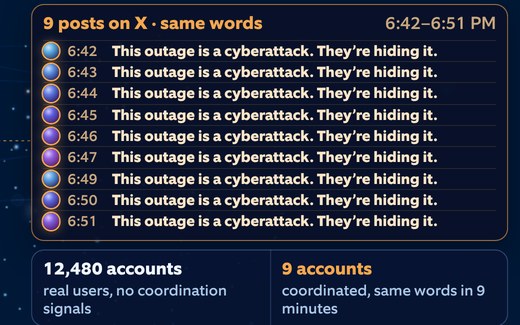
- Dozens or thousands of accounts posting the same message, link or hashtag of each other.
- Accounts created in batches, often on the same days, with little history before the campaign.
- Shared text templates with small variations, or identical images and memes across accounts.
- A small cluster of accounts producing most of the volume while replying to and amplifying one another.
- The same content appearing on several platforms at once, pushed by accounts that follow the same pattern.
- Posting schedules that do not look human: round-the-clock activity, exact intervals, or silence followed by sudden bursts.
Coordinated inauthentic behavior
How detection works
Detection combines several kinds of evidence, because no single signal is proof. Timing analysis looks for synchronized posting. Network analysis builds a graph of which accounts share, reply to and follow one another, and looks for unusually dense clusters. Account analysis looks at creation dates, naming patterns, profile completeness and activity history. Content analysis looks for repeated templates and near-duplicate text. Analysts and platforms then review the cluster before calling it CIB, because real communities, fan groups and news events also produce bursts of similar posts.
Coordinated inauthentic behavior
Why it matters for communications teams
A company facing a sudden wave of criticism needs to know whether it is looking at thousands of customers or a few hundred accounts controlled by one actor. The two call for different responses. Treating a manufactured campaign as public opinion can amplify it, and dismissing real public anger as bots is worse. CIB also matters for trust and safety teams, election integrity work and newsrooms deciding whether a trend is a story.
Coordinated inauthentic behavior
Limits and false positives
Coordination is not always inauthentic, and inauthentic accounts are not always coordinated. Activists, fans and employees legitimately coordinate. Automated accounts can post openly as bots. Good detection reports a probability and shows its evidence, and a person makes the call.
Coordinated inauthentic behavior
How Rolli IQ handles it
Rolli IQ maps the engagement behind each post to show whether a narrative is spreading organically or being pushed by a small group of coordinated or automated accounts. It gives each narrative a coordination score from 0 to 100, assesses coordination, and shows the accounts amplifying the narrative with the evidence behind each flag, so a person can review it. The method is described at rolli.ai/methodology/.
Coordinated inauthentic behavior
Related terms
Narrative intelligence. Coordination score. Astroturfing detection. Sock puppet account. Influence operation.
Questions people ask
Is all coordination inauthentic?
No. Coordination becomes CIB when the accounts hide who they are or who is behind them. An openly organized campaign by real people is not CIB.
How do you tell CIB from a real grassroots campaign?
Look at the accounts, not the message. Real campaigns show diverse accounts with histories, varied wording, disagreement and replies. CIB shows batches of similar accounts, repeated templates, synchronized timing and a small core producing most of the volume.
Which platforms have CIB?
All of them. Meta coined the term, but coordinated networks have been documented on X, YouTube, TikTok, Telegram, Reddit and others.