

In its H2 2026 Adversarial Threat Report, published in August 2026, Meta wrote that AI-generated content has become “a near-standard component of influence operation tradecraft.” Meta found signs of generative AI in every coordinated inauthentic behavior network in that report. At the simple end were AI-made profile pictures; at the other were automated systems turning out text, images and video. Meta said that was a marked change from a year before.
This post looks at what that change means for detection, using Meta’s report and Rolli’s published analyses of coordinated campaigns.
What Changed: AI Became Routine
Meta describes three trends. The first is what it calls “full-stack synthetic personas”: accounts built around invented people, with AI-made pictures and videos of the same face and generated biographies, articles or graphics to back them up. Meta found them in a network that originated in Russia.
The second is automation. Meta describes a commercial operation based in Israel that connected to an AI platform’s API so that clusters of automated accounts could post AI-written comments at scale, boosting engagement on the network’s main accounts. The third is video: Meta saw AI-made video from networks tied to Russia and Iran and from companies that run influence operations for paying clients, and said forensic analysis could still spot most of the video it reviewed.
Meta also says it has not yet seen agentic AI, systems that plan and carry out multi-step tasks on their own, deployed extensively by threat actors, and that it is watching for it.
Why Behavioral Signals Still Work
Meta’s assessment is that behavioral detection still works against AI-enabled influence operations. It says the networks it disrupted were found through behavioral signals, technical indicators and network analysis, which AI does not easily disguise. Its argument is that operators cannot automate the parts that need real-world infrastructure and coordination between people. Meta adds that the advantage is not permanent, and expects more capable AI agents to put new pressure on defenders.
Rolli’s published analyses show the kind of evidence that does not depend on how a post is written. In #SchuldenDE, the 1,341 coordinated accounts gave themselves away through their profiles: all listed German cities as their locations, and their descriptions were German quotes that Rolli traced to Russian websites.
In Rolli’s #No2ULEZ analysis, two of the three anti-ULEZ campaign websites shared an IP address.
In Rolli’s #BanTheADL analysis, clusters of accounts shared profile images and retweeted the same accounts.
Detection in Practice
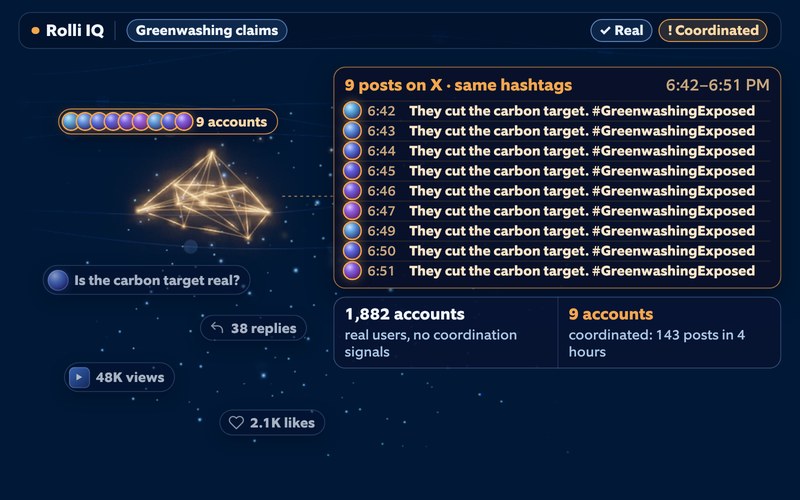
Timing is another signal that well-written text does not hide. Rolli’s analysis of the TSA PreCheck announcement, published on February 24, 2026, found that roughly 58% of the initial burst of conversation came from a cluster of accounts sharing near-identical language, posting within tight time windows and retweeting each other at above-baseline rates.
Illustrative example: a set of new accounts posts fluent, varied complaints about Veltrane, a fictional company, each written by an AI model. No two posts match. But the accounts were created in the same week, post within minutes of each other and mostly amplify one another. The text gives nothing away; the behavior does.
Rolli’s methodology describes Rolli IQ’s coordination score as a weighted composite of four signal families, velocity and timing, account behavior, network structure, and content and language, and says no single signal is proof of inauthenticity. Rolli IQ gives each investigation a coordination score from 0 to 100, detects coordination and shows the evidence behind each flag, across 9+ platforms.
Conclusion
What changed by 2026, in Meta’s reporting, is not that AI appeared in influence operations but that it became routine. What has not changed, on Meta’s assessment, is how the networks were caught: by how they behaved. For a newsroom or a communications team, the lesson is practical: judge a narrative by how its accounts behave, not by how well its posts are written.
About the Author
Rolli Newsroom
Rolli's research team covers narrative intelligence, influence operations, coordinated inauthentic behavior, and cross-platform social analysis.
RelatedPlatform overview →Rolli IQ scoring →API access →Security intelligence →Communications →Pricing →