

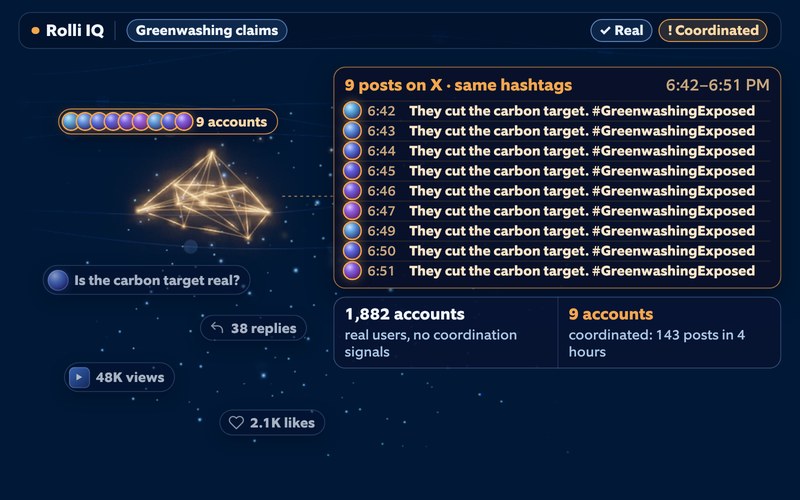
Influence operations are usually discussed in terms of elections and geopolitics, but companies can be targets too. This post looks at one documented case, what platform investigators say about who runs these operations, and the signals Rolli’s own analyses have used to find coordination.
In June 2022, the threat intelligence firm Mandiant reported that DRAGONBRIDGE, a pro-People’s Republic of China influence campaign, had targeted Lynas Rare Earths, an Australian mining company. According to Mandiant, the campaign’s posts attacked Lynas over its alleged environmental record and urged protests against a rare earths processing plant the company planned in Texas.
Why a Company Can Be a Target
Mandiant framed the campaign as commercial as well as political: its headline says the campaign aimed to “Thwart Rivalry to PRC Market Dominance.” It reported that DRAGONBRIDGE later turned to two more companies, Appia Rare Earths & Uranium in Canada and USA Rare Earth in the United States, with negative messages about production the two were planning or considering.
The tactics were those of political influence operations. Mandiant said the campaign ran fake accounts on social media and at least one forum, including accounts posing as Texas residents “to feign concern over environmental and health issues surrounding the plant,” and that some posted to a public Facebook group opposed to Lynas.
Mandiant also found that the activity drew little engagement from what appeared to be real users. A campaign can target a company without succeeding.
The Signals Investigators Use
Platforms find these networks mostly through behavior. Meta’s August 2026 threat report says the influence operations it disrupted were found through how the accounts behaved, technical clues and the links between them. It also describes a market behind them, in which operators hire out work to freelancers and contracting firms in other countries. Several campaigns Meta removed were linked to the Social Design Agency, which Meta calls “a Russian IT and public relations company.”
Researchers working from public data rely on what accounts reveal about themselves. In Rolli’s #SchuldenDE analysis, 1,341 coordinated accounts presented themselves as Germans, but their profile descriptions were German quotes that Rolli traced to Russian websites. One misspelled city name, used as a location by six of the accounts, appeared with the same misspelling on a Russian website.
Rolli’s analysis of the Fukushima wastewater debate, published on March 12, 2025, traced how the slogan “If it’s safe, put it in Japan” moved from a local Facebook news channel through state-affiliated media to two Chinese counsellors, who posted the identical phrase on consecutive days.
What This Means in Practice
Illustrative example: Pellbrook Energy, a fictional company, announces a new plant. Within days, accounts that say they live near the site post near-identical worries about pollution; several were created in the same month, and many follow one another. Those signals do not show who is behind the accounts, but they are a reason to check before treating the posts as local opinion.
Naming a government is a separate and harder step. Mandiant presented its attribution of the Lynas activity to DRAGONBRIDGE as an assessment made with high confidence, not as a certainty.
Rolli IQ gives each investigation a coordination score from 0 to 100, detects coordination and shows the evidence behind each flag, across 9+ platforms. Rolli’s methodology describes the score as probabilistic: an aid for human decision-makers, not an automated verdict.
Conclusion
Influence campaigns against companies are documented, though the public record is thinner than for elections. The DRAGONBRIDGE case shows the pattern: political tradecraft, a commercial motive and accounts pretending to be locals. It also shows the limit, since the campaign drew little real engagement. For a company, the useful question is the same as for any narrative: before acting on its volume, check whether the volume is real.
About the Author
Rolli Newsroom
Analysis and intelligence research published by the Rolli IQ team.
RelatedPlatform overview →Rolli IQ scoring →API access →Security intelligence →Communications →Pricing →