

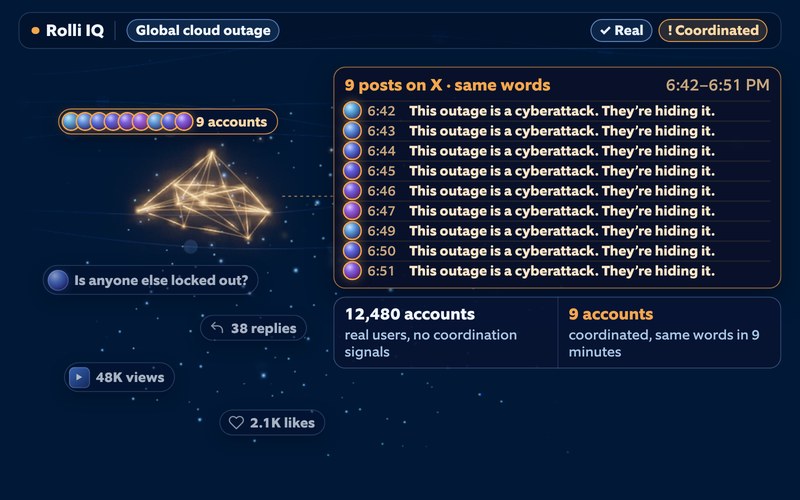
Mentions, impressions and reach count every post the same way, whoever wrote it. When part of a conversation comes from coordinated accounts, those numbers describe the campaign as much as the public. This post looks at what the measurement profession’s own standards say, and at what Rolli’s published analyses found when the coordinated layer was separated out.
AMEC, the International Association for the Measurement and Evaluation of Communication, published the fourth version of its Barcelona Principles in June 2025. Principle 5 says invalid measures “such as advertising value equivalents (AVEs) should not be used,” and asks practitioners to judge communication by what it achieves.
Why Traditional Metrics Fail in Adversarial Environments
Rolli’s analysis of the TSA PreCheck expansion, published on February 24, 2026, recorded a 340% spike in related conversation across X, Reddit and Facebook within 90 minutes of the announcement. Counted as mentions, that looked like enthusiasm. But roughly 58% of the initial burst came from one cluster of accounts using near-identical language, and travelers with established posting patterns were net-neutral. Rolli concluded that a strategist reading only the overall numbers would have taken the announcement as uniformly well received.
Coordinated amplification can also make a small movement look bigger. Rolli’s #BanTheADL analysis, published on September 10, 2024, found the hashtag carried both by real commentators and by clusters of inauthentic accounts, and concluded that the mix made the movement look larger and more unified than it was.
What Coordination-Adjusted Metrics Look Like
The measurement standards point the same way. Under Principle 7 of the Barcelona Principles 4.0, AMEC says research methods should decide how they will identify and weigh sources of different trustworthiness, and it names bot accounts on social media as one example.
Illustrative example: a product launch by Wrenmoor, a fictional company, draws 20,000 mentions in a day. If a quarter of them come from one cluster of accounts posting the same lines within minutes of each other, the report should say so, and the sentiment figure should be shown both with and without that cluster.
Attention is a different measure from coverage. Rolli’s analysis of the DHS shutdown, published on February 17, 2026, found that its momentum index peaked at 38 out of 100 on day one, against more than 80 for the 2018–2019 shutdown, and that the r/politics thread stayed below 1,500 upvotes. Rolli warned that communicators who judge public attention by media prominence risk being misled.
Implementing Coordination Metrics in a PR Function
AMEC’s principles also ask measurement programs to be clear about their data sources and sampling, to document their methods, and, when they use AI or automation, to say so and keep a human in the loop.
Rolli IQ gives each investigation a coordination score from 0 to 100, detects coordination and shows the evidence behind each flag, across 9+ platforms. Rolli’s methodology describes the score as probabilistic: an aid for human decision-makers, not an automated verdict.
Conclusion
Volume still matters; it is just not the whole measure. The measurement profession has already moved away from AVEs toward outcomes, and its latest principles ask practitioners to decide how they treat bot accounts. Rolli’s analyses show why that matters: when a conversation has a coordinated layer, the headline numbers can describe the campaign rather than the public.
About the Author
Rolli Newsroom
Analysis and intelligence research published by the Rolli IQ team.
RelatedPlatform overview →Rolli IQ scoring →API access →Security intelligence →Communications →Pricing →